ShipsBy Patrick Karsh
The UK Marine Accident Investigation Branch (MAIB) published its final report on October 8, 2026, into the death of a crew member aboard P&O Cruises' Arvia. A 35-year-old electrical technician was fatally injured on October 26, 2025, while inspecting a passenger elevator after overnight repairs. Report 20/2026 identifies five safety issues, makes one recommendation to Carnival UK, and records the changes the company has already made across its fleet. The report announcement and the full report are on gov.uk.
What happened
Arvia was sailing from Southampton, England, to Santa Cruz de Tenerife in the Canary Islands with 5,299 passengers and 1,681 crew on board. At about 5:52 a.m. ship's time, the ship was roughly 75 nautical miles northwest of Cape Finisterre, Spain. The technician entered the shaft of passenger elevator 14 from deck 14 to inspect the car. The elevator had been returned to normal operation for testing before the inspection, and the car was believed to be stationary. The landing doors on decks 11 and 14 then closed, which restored the elevator's safety circuit. The car responded to a stored call for deck 17 and moved, and the technician was crushed between the car and the side of the shaft. The ship diverted to A Coruña, Spain.
Arvia is registered in Bermuda. The MAIB carried out the investigation on behalf of the Bermuda Ship Registry under an agreement with the Red Ensign Group. As with all MAIB work, the aim is to prevent future accidents, not to assign blame.
Five safety issues
The report lists five safety issues. First, communication and planning for the inspection were ineffective. The senior electro-technical officer and the technician did not share an understanding of the task. Second, positive control of the elevator had not been established before the technician entered the shaft. Third, the system of work relied on self-resetting door interlocks as a barrier against elevator movement. Those interlocks reset on their own as soon as the doors close, so they were not an effective barrier. Fourth, the permit-to-work process did not catch that the task had moved beyond its authorized scope. Fifth, elevator maintenance training and competence checks were inconsistent.
The MAIB also noted two findings that did not directly contribute to the accident. The officer who raised the permit and supervised the work, the ship's third electro-technical officer, had not received formal elevator safety training. And a faulty door release on deck 12 changed the access arrangements, which indirectly led to a different route into the shaft.
The recommendation and what Carnival UK has changed
Recommendation 2026/159 asks Carnival UK Ltd to review its use of self-resetting elevator door interlocks as a safety barrier against elevators being activated during maintenance or inspection.
Carnival UK, the Southampton-based operator of P&O Cruises and Cunard, has already acted on the other findings. According to the report, the company has told every senior electro-technical officer in its fleet to go through the rules for elevator maintenance and elevator rescue with their teams. That covers communication between all crew involved in the work, a ban on using the fixed ladder inside the elevator shaft to reach the top of the car, and correct handling of the permit to work. Carnival UK has also updated its training materials with safety information specific to the elevator maker.
Two further steps target competence. Under an interim rule, anyone involved in elevator maintenance must have completed basic safety training within the previous six months. That training must be run by the elevator maker or a third-party elevator service supplier. The company will revisit the rule after a review of its competency framework. Carnival UK has also introduced a competency check. Crew who finish basic elevator safety training must pass a test afterward, and both the certificate and the test result are formally recorded.
Why it matters for guests
Almost 7,000 people were on board Arvia on this voyage, and elevators are among the hardest-working machines on any large cruise ship. Much of the maintenance happens overnight, out of sight of guests. That is why the systems behind the work matter so much. The report does not suggest that passengers were at risk from the elevator itself. Its focus is on how crew are protected while they maintain it.
The changes apply across Carnival UK rather than to one ship, so they cover the whole P&O Cruises fleet and Cunard's ships as well. Guests are unlikely to notice any difference on board. What has changed is the training, the permits, and the communication required before a technician steps into an elevator shaft. The open item is the recommendation on self-resetting interlocks, which Carnival UK has been asked to review. Cruise Industry News also covered the report. No separate P&O Cruises statement on the final report had been published at the time of writing.
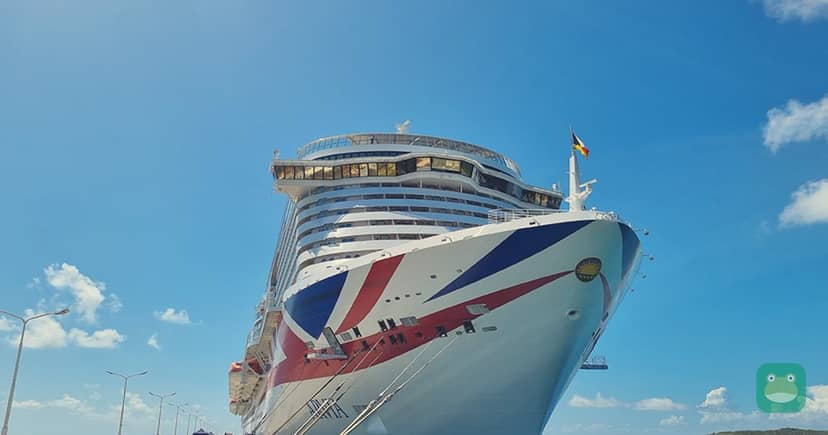
Photo: P&O Cruises' Arvia, as pictured on the MAIB's report announcement page · Marine Accident Investigation Branch (Crown copyright, Open Government Licence v3.0)
More onArviaP&O Cruises